Domain vierteltakt.de kaufen?
Wir ziehen mit dem Projekt
vierteltakt.de um.
Sind Sie am Kauf der Domain
vierteltakt.de interessiert?
domain@kv-gmbh.de · 0541-91531010
Domain vierteltakt.de kaufen?
Wie berechne ich den Meterpreis?
Der Meterpreis wird berechnet, indem der Gesamtpreis eines Produkts durch die Länge in Metern geteilt wird. Zum Beispiel, wenn ein Stoff 10 Euro kostet und eine Länge von 2 Metern hat, beträgt der Meterpreis 5 Euro. **
Wie berechnet man den Meterpreis aus dem Stückpreis?
Um den Meterpreis aus dem Stückpreis zu berechnen, muss man den Stückpreis durch die Länge des Stücks teilen. Das Ergebnis ist dann der Meterpreis. **


Ähnliche Suchbegriffe für Meterpreis
Top-Angebote
Produkte zum Begriff Meterpreis:
-
Audioquest Audioquest Rocket 11 - schwarz - MeterpreisAudioquest Rocket 11 Rocket 11 is a high-performance, low-noise, CL3/FT4-certified cable designed to quickly and easily accommodate either Full-Range or Single-BiWire applications, making it an outstanding choice for custom installers and enthusiasts alike. With no breakouts, pants, or braids to cut back and dress, preparation is as simple as can be. AudioQuest SureGrip 100 or SureGrip 300 spades or bananas, featuring Direct-Silver plating with no intermediate layer of distortion-causing nickel, are the perfect complement to Rocket 11. Rocket 11 is CL3/FT4-certified. SEMI-SOLID CONCENTRIC PACKED LONG-GRAIN COPPER (LGC) CONDUCTORS In a conventional multi-strand cable, distortion caused by electrical and magnetic strand interaction is compounded as each strand changes position within the bundle. In an AQ Semi-Solid Concentric Packed cable, strands within the bundle maintain their fixed relationships, significantly reducing distortion. SEMI-SOLID TRUE-CONCENTRIC CONDUCTOR DESIGN In a True-Concentric conductor design, each successive layer of stranded conductor spirals in the direction opposite of its underlying layer. This technique eliminates the lines of contact between adjacent conductor layers, while increasing pressure at the contact points, thereby significantly reducing electrical-contact strand interaction and its accompanying distortion. IDEAL FOR FULL-RANGE OR SINGLE-BIWIRE CONFIGURATIONS Use Rocket 11 as a full-range cable, with red (+) and black (-) conductors grouped together, or, when the speakers provide separate bass and treble inputs, further optimize system performance by biwiring. DOUBLE LOW-INDUCTANCE TWISTED PAIR GEOMETRY A typical speaker cable with parallel conductors has fairly high inductance, smearing energy across time, which results in sound that is dull and unfocused. In Rocket 11, the two conductors in each half of the cable are twisted around one another, providing lower inductance, greater clarity, and superior bass-to-treble frequency extension Lautsprecherkabel, Audioquest Rocket 1120,00 €*Versand: 0,00 €Sichere Weiterleitung zum Anbieter
-
Audioquest Audioquest Rocket 11 - weiss - MeterpreisAudioquest Rocket 11 Rocket 11 is a high-performance, low-noise, CL3/FT4-certified cable designed to quickly and easily accommodate either Full-Range or Single-BiWire applications, making it an outstanding choice for custom installers and enthusiasts alike. With no breakouts, pants, or braids to cut back and dress, preparation is as simple as can be. AudioQuest SureGrip 100 or SureGrip 300 spades or bananas, featuring Direct-Silver plating with no intermediate layer of distortion-causing nickel, are the perfect complement to Rocket 11. Rocket 11 is CL3/FT4-certified. SEMI-SOLID CONCENTRIC PACKED LONG-GRAIN COPPER (LGC) CONDUCTORS In a conventional multi-strand cable, distortion caused by electrical and magnetic strand interaction is compounded as each strand changes position within the bundle. In an AQ Semi-Solid Concentric Packed cable, strands within the bundle maintain their fixed relationships, significantly reducing distortion. SEMI-SOLID TRUE-CONCENTRIC CONDUCTOR DESIGN In a True-Concentric conductor design, each successive layer of stranded conductor spirals in the direction opposite of its underlying layer. This technique eliminates the lines of contact between adjacent conductor layers, while increasing pressure at the contact points, thereby significantly reducing electrical-contact strand interaction and its accompanying distortion. IDEAL FOR FULL-RANGE OR SINGLE-BIWIRE CONFIGURATIONS Use Rocket 11 as a full-range cable, with red (+) and black (-) conductors grouped together, or, when the speakers provide separate bass and treble inputs, further optimize system performance by biwiring. DOUBLE LOW-INDUCTANCE TWISTED PAIR GEOMETRY A typical speaker cable with parallel conductors has fairly high inductance, smearing energy across time, which results in sound that is dull and unfocused. In Rocket 11, the two conductors in each half of the cable are twisted around one another, providing lower inductance, greater clarity, and superior bass-to-treble frequency extension Lautsprecherkabel, Audioquest Rocket 1120,00 €*Versand: 0,00 €Sichere Weiterleitung zum Anbieter
-
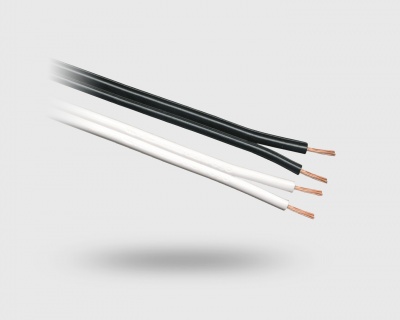
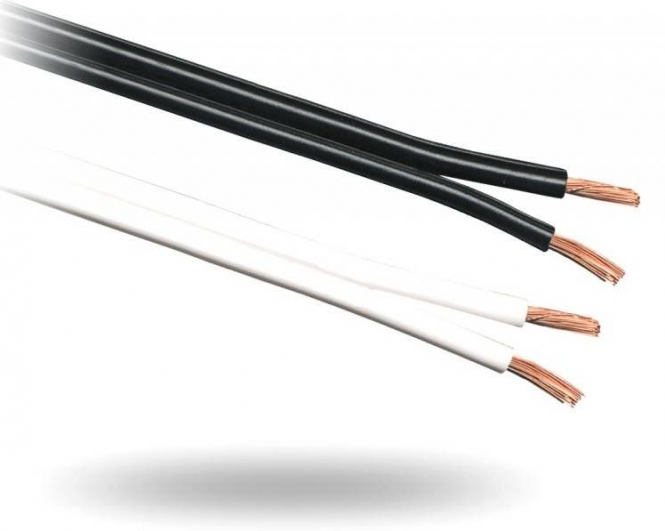
QED QED - Profile 42 strand - schwarz - MeterpreisQED Profile 42 Strand - 2x0,75mm - Lautsprecherkabel Das als Industriestandard geltende QED 42 Strand Lautsprecherkabel. Technische Daten: -Kabelquerschnitt: 0,75mm² -Aufbau in Form einer 8 -In schwarz oder weiß lieferbar -PVC-Dielektrikum -Stecker-Außendurchmesser: 2,7mm -Schleifenwiderstand: 0,046 Ω/m -Kapazität: 49 pF/m -Induktivität: 0,75 μH/m -Verlustfaktor: 0,0500 Lautsprecherkabel, QED Profile 42 strand1,60 €*Versand: 0,00 €Sichere Weiterleitung zum Anbieter
-
QED QED - Profile 79 strand - weiss - MeterpreisQED Profile 79 Strand - 2x2,5mm - Lautsprecherkabel Der große Bruder des als Industriestandard geltenden QED 42 Strand Lautsprecherkabels. Gewann als einziges Kabel Jemals die angesehene "Federation of British Audio Test of Time" Auszeichnung. Technische Daten: -Kabelquerschnitt: 2,5mm² -Aufbau in Form einer 8 -In schwarz oder weiß lieferbar -PVC-Dielektrikum -Stecker-Außendurchmesser: 4mm -Schleifenwiderstand: 0,016 Ω/m -Kapazität: 58 pF/m -Induktivität: 0,66 μH/m -Verlustfaktor: 0,0900 Lautsprecherkabel, QED Profile 79 strand2,99 €*Versand: 0,00 €Sichere Weiterleitung zum Anbieter


-
Wie kann man den Kilopreis in den Meterpreis umrechnen?
Um den Kilopreis in den Meterpreis umzurechnen, muss man zunächst wissen, wie viele Meter in einem Kilogramm enthalten sind. Wenn man das Verhältnis kennt, kann man den Kilopreis durch die Anzahl der Meter teilen, um den Meterpreis zu erhalten. Zum Beispiel, wenn der Kilopreis 10 Euro beträgt und in einem Kilogramm 5 Meter enthalten sind, beträgt der Meterpreis 2 Euro. **
-
Wie kann man den Stückpreis in einen Meterpreis umrechnen?
Um den Stückpreis in einen Meterpreis umzurechnen, muss man wissen, wie viele Meter in einem Stück enthalten sind. Dann teilt man den Stückpreis durch die Anzahl der Meter und erhält den Meterpreis. Beispiel: Wenn ein Stück 2 Meter lang ist und 10 Euro kostet, beträgt der Meterpreis 10 Euro geteilt durch 2 Meter, also 5 Euro pro Meter. **
-
Wofür werden Taktgeber in der Musik verwendet und wie beeinflussen sie den Rhythmus eines Stücks?
Taktgeber werden in der Musik verwendet, um den Rhythmus eines Stücks zu bestimmen und die Zeit zu messen. Sie geben den Musikern eine klare Struktur und helfen dabei, im Takt zu bleiben. Durch den Taktgeber wird der Rhythmus eines Stücks definiert und die verschiedenen rhythmischen Elemente koordiniert. **
-
Was für verschiedene Taktgeber werden in der Musik verwendet und wie beeinflussen diese den Rhythmus?
In der Musik werden verschiedene Taktgeber wie Metronome, Schlagzeug oder Dirigenten verwendet, um den Rhythmus zu bestimmen. Diese Taktgeber geben das Tempo vor und helfen den Musikern, im Takt zu bleiben. Sie beeinflussen den Rhythmus, indem sie die Geschwindigkeit und Betonung der Noten festlegen. **

Welche Instrumente und Tonabfolgen erzeugen harmonische Klänge in der Musik?
Instrumente wie Klavier, Gitarre und Streichinstrumente erzeugen harmonische Klänge durch das Spielen von Akkorden. Tonabfolgen wie Dur- und Mollakkorde sowie Quinten und Oktaven tragen ebenfalls zur Harmonie in der Musik bei. Die richtige Kombination von Instrumenten und Tonabfolgen schafft eine angenehme und ausgewogene Klangfülle. **
Wie werden verschiedene Percussion-Instrumente in der Musik eingesetzt, um Rhythmus und Dynamik zu erzeugen?
Percussion-Instrumente wie Trommeln, Becken und Shaker werden verwendet, um den Rhythmus eines Musikstücks zu betonen und zu unterstützen. Durch unterschiedliche Schlagtechniken und Spielweisen können Percussionisten Dynamik und Spannung erzeugen. Die Vielfalt an Percussion-Instrumenten ermöglicht es, verschiedene Klangfarben und Texturen in die Musik einzubringen. **
Top-Angebote
Produkte zum Begriff Meterpreis:
-
Meier, Christiane: Instrumente, Noten, GesangInstrumente, Noten, Gesang , Differenzierte Materialien zur Entwicklung und Festigung von Grundwissen im Musikunterricht (2. bis 4. Klasse) , Zündkabel & Zündkabelstecker > Elektrik & Zündungen , Erscheinungsjahr: 20230102, Produktform: Kassette, Inhalt/Anzahl: 1, Inhalt/Anzahl: 1, Beilage: E-Bundle, Titel der Reihe: Grundwissen Mathematik##, Autoren: Meier, Christiane, Seitenzahl/Blattzahl: 80, Keyword: 2. bis 4. Klasse; Grundschule; Musik; Themenübergreifend, Fachschema: Musikunterricht / Lehrermaterial, Themenvorschläge, Bildungsmedien Fächer: Musik, Fachkategorie: Schule und Lernen, Bildungszweck: für den Primarbereich, Altersempfehlung / Lesealter: 23, Genaues Alter: GRS, Warengruppe: HC/Schulbücher/Unterrichtsmat./Lehrer, Fachkategorie: Unterrichtsmaterialien, Schulform: GRS, Text Sprache: ger, Sender’s product category: BUNDLE, Verlag: Persen Verlag i.d. AAP, Verlag: Persen Verlag i.d. AAP, Länge: 293, Breite: 206, Höhe: 13, Gewicht: 500, Produktform: Blätter, Genre: Schule und Lernen, Genre: Schule und Lernen, Beinhaltet: B0000064958001 9783403208969-2 B0000064958002 9783403208969-1, Herkunftsland: DEUTSCHLAND (DE), Katalog: deutschsprachige Titel, Katalog: Gesamtkatalog, Katalog: Lagerartikel, Book on Demand, ausgew. Medienartikel, Relevanz: 0002, Tendenz: -1, Schulform: Grundschule, Unterkatalog: AK, Unterkatalog: Bücher, Unterkatalog: Hardcover, Unterkatalog: Lagerartikel, Unterkatalog: Schulbuch, WolkenId: 283725923,99 €*Versand: 0,00 €Sichere Weiterleitung zum Anbieter
-
Audioquest Audioquest Rocket 11 - schwarz - MeterpreisAudioquest Rocket 11 Rocket 11 is a high-performance, low-noise, CL3/FT4-certified cable designed to quickly and easily accommodate either Full-Range or Single-BiWire applications, making it an outstanding choice for custom installers and enthusiasts alike. With no breakouts, pants, or braids to cut back and dress, preparation is as simple as can be. AudioQuest SureGrip 100 or SureGrip 300 spades or bananas, featuring Direct-Silver plating with no intermediate layer of distortion-causing nickel, are the perfect complement to Rocket 11. Rocket 11 is CL3/FT4-certified. SEMI-SOLID CONCENTRIC PACKED LONG-GRAIN COPPER (LGC) CONDUCTORS In a conventional multi-strand cable, distortion caused by electrical and magnetic strand interaction is compounded as each strand changes position within the bundle. In an AQ Semi-Solid Concentric Packed cable, strands within the bundle maintain their fixed relationships, significantly reducing distortion. SEMI-SOLID TRUE-CONCENTRIC CONDUCTOR DESIGN In a True-Concentric conductor design, each successive layer of stranded conductor spirals in the direction opposite of its underlying layer. This technique eliminates the lines of contact between adjacent conductor layers, while increasing pressure at the contact points, thereby significantly reducing electrical-contact strand interaction and its accompanying distortion. IDEAL FOR FULL-RANGE OR SINGLE-BIWIRE CONFIGURATIONS Use Rocket 11 as a full-range cable, with red (+) and black (-) conductors grouped together, or, when the speakers provide separate bass and treble inputs, further optimize system performance by biwiring. DOUBLE LOW-INDUCTANCE TWISTED PAIR GEOMETRY A typical speaker cable with parallel conductors has fairly high inductance, smearing energy across time, which results in sound that is dull and unfocused. In Rocket 11, the two conductors in each half of the cable are twisted around one another, providing lower inductance, greater clarity, and superior bass-to-treble frequency extension Lautsprecherkabel, Audioquest Rocket 1120,00 €*Versand: 0,00 €Sichere Weiterleitung zum Anbieter
-
Audioquest Audioquest Rocket 11 - weiss - MeterpreisAudioquest Rocket 11 Rocket 11 is a high-performance, low-noise, CL3/FT4-certified cable designed to quickly and easily accommodate either Full-Range or Single-BiWire applications, making it an outstanding choice for custom installers and enthusiasts alike. With no breakouts, pants, or braids to cut back and dress, preparation is as simple as can be. AudioQuest SureGrip 100 or SureGrip 300 spades or bananas, featuring Direct-Silver plating with no intermediate layer of distortion-causing nickel, are the perfect complement to Rocket 11. Rocket 11 is CL3/FT4-certified. SEMI-SOLID CONCENTRIC PACKED LONG-GRAIN COPPER (LGC) CONDUCTORS In a conventional multi-strand cable, distortion caused by electrical and magnetic strand interaction is compounded as each strand changes position within the bundle. In an AQ Semi-Solid Concentric Packed cable, strands within the bundle maintain their fixed relationships, significantly reducing distortion. SEMI-SOLID TRUE-CONCENTRIC CONDUCTOR DESIGN In a True-Concentric conductor design, each successive layer of stranded conductor spirals in the direction opposite of its underlying layer. This technique eliminates the lines of contact between adjacent conductor layers, while increasing pressure at the contact points, thereby significantly reducing electrical-contact strand interaction and its accompanying distortion. IDEAL FOR FULL-RANGE OR SINGLE-BIWIRE CONFIGURATIONS Use Rocket 11 as a full-range cable, with red (+) and black (-) conductors grouped together, or, when the speakers provide separate bass and treble inputs, further optimize system performance by biwiring. DOUBLE LOW-INDUCTANCE TWISTED PAIR GEOMETRY A typical speaker cable with parallel conductors has fairly high inductance, smearing energy across time, which results in sound that is dull and unfocused. In Rocket 11, the two conductors in each half of the cable are twisted around one another, providing lower inductance, greater clarity, and superior bass-to-treble frequency extension Lautsprecherkabel, Audioquest Rocket 1120,00 €*Versand: 0,00 €Sichere Weiterleitung zum Anbieter
-
Wie berechne ich den Meterpreis?
Der Meterpreis wird berechnet, indem der Gesamtpreis eines Produkts durch die Länge in Metern geteilt wird. Zum Beispiel, wenn ein Stoff 10 Euro kostet und eine Länge von 2 Metern hat, beträgt der Meterpreis 5 Euro. **
-
Wie berechnet man den Meterpreis aus dem Stückpreis?
Um den Meterpreis aus dem Stückpreis zu berechnen, muss man den Stückpreis durch die Länge des Stücks teilen. Das Ergebnis ist dann der Meterpreis. **
-
Wie kann man den Kilopreis in den Meterpreis umrechnen?
Um den Kilopreis in den Meterpreis umzurechnen, muss man zunächst wissen, wie viele Meter in einem Kilogramm enthalten sind. Wenn man das Verhältnis kennt, kann man den Kilopreis durch die Anzahl der Meter teilen, um den Meterpreis zu erhalten. Zum Beispiel, wenn der Kilopreis 10 Euro beträgt und in einem Kilogramm 5 Meter enthalten sind, beträgt der Meterpreis 2 Euro. **
-
Wie kann man den Stückpreis in einen Meterpreis umrechnen?
Um den Stückpreis in einen Meterpreis umzurechnen, muss man wissen, wie viele Meter in einem Stück enthalten sind. Dann teilt man den Stückpreis durch die Anzahl der Meter und erhält den Meterpreis. Beispiel: Wenn ein Stück 2 Meter lang ist und 10 Euro kostet, beträgt der Meterpreis 10 Euro geteilt durch 2 Meter, also 5 Euro pro Meter. **
Ähnliche Suchbegriffe für Meterpreis
-
QED QED - Profile 42 strand - schwarz - MeterpreisQED Profile 42 Strand - 2x0,75mm - Lautsprecherkabel Das als Industriestandard geltende QED 42 Strand Lautsprecherkabel. Technische Daten: -Kabelquerschnitt: 0,75mm² -Aufbau in Form einer 8 -In schwarz oder weiß lieferbar -PVC-Dielektrikum -Stecker-Außendurchmesser: 2,7mm -Schleifenwiderstand: 0,046 Ω/m -Kapazität: 49 pF/m -Induktivität: 0,75 μH/m -Verlustfaktor: 0,0500 Lautsprecherkabel, QED Profile 42 strand1,60 €*Versand: 0,00 €Sichere Weiterleitung zum Anbieter
-
QED QED - Profile 79 strand - weiss - MeterpreisQED Profile 79 Strand - 2x2,5mm - Lautsprecherkabel Der große Bruder des als Industriestandard geltenden QED 42 Strand Lautsprecherkabels. Gewann als einziges Kabel Jemals die angesehene "Federation of British Audio Test of Time" Auszeichnung. Technische Daten: -Kabelquerschnitt: 2,5mm² -Aufbau in Form einer 8 -In schwarz oder weiß lieferbar -PVC-Dielektrikum -Stecker-Außendurchmesser: 4mm -Schleifenwiderstand: 0,016 Ω/m -Kapazität: 58 pF/m -Induktivität: 0,66 μH/m -Verlustfaktor: 0,0900 Lautsprecherkabel, QED Profile 79 strand2,99 €*Versand: 0,00 €Sichere Weiterleitung zum Anbieter
-
Wofür werden Taktgeber in der Musik verwendet und wie beeinflussen sie den Rhythmus eines Stücks?
Taktgeber werden in der Musik verwendet, um den Rhythmus eines Stücks zu bestimmen und die Zeit zu messen. Sie geben den Musikern eine klare Struktur und helfen dabei, im Takt zu bleiben. Durch den Taktgeber wird der Rhythmus eines Stücks definiert und die verschiedenen rhythmischen Elemente koordiniert. **
-
Was für verschiedene Taktgeber werden in der Musik verwendet und wie beeinflussen diese den Rhythmus?
In der Musik werden verschiedene Taktgeber wie Metronome, Schlagzeug oder Dirigenten verwendet, um den Rhythmus zu bestimmen. Diese Taktgeber geben das Tempo vor und helfen den Musikern, im Takt zu bleiben. Sie beeinflussen den Rhythmus, indem sie die Geschwindigkeit und Betonung der Noten festlegen. **
-
Welche Instrumente und Tonabfolgen erzeugen harmonische Klänge in der Musik?
Instrumente wie Klavier, Gitarre und Streichinstrumente erzeugen harmonische Klänge durch das Spielen von Akkorden. Tonabfolgen wie Dur- und Mollakkorde sowie Quinten und Oktaven tragen ebenfalls zur Harmonie in der Musik bei. Die richtige Kombination von Instrumenten und Tonabfolgen schafft eine angenehme und ausgewogene Klangfülle. **
-
Wie werden verschiedene Percussion-Instrumente in der Musik eingesetzt, um Rhythmus und Dynamik zu erzeugen?
Percussion-Instrumente wie Trommeln, Becken und Shaker werden verwendet, um den Rhythmus eines Musikstücks zu betonen und zu unterstützen. Durch unterschiedliche Schlagtechniken und Spielweisen können Percussionisten Dynamik und Spannung erzeugen. Die Vielfalt an Percussion-Instrumenten ermöglicht es, verschiedene Klangfarben und Texturen in die Musik einzubringen. **
* Alle Preise verstehen sich inklusive der gesetzlichen Mehrwertsteuer und ggf. zuzüglich Versandkosten. Die Angebotsinformationen basieren auf den Angaben des jeweiligen Shops und werden über automatisierte Prozesse aktualisiert. Eine Aktualisierung in Echtzeit findet nicht statt, so dass es im Einzelfall zu Abweichungen kommen kann. ** Hinweis: Teile dieses Inhalts wurden von KI erstellt.